

What the SBA's New Quality of Earnings Requirement Means for Business Acquisitions
The SBA's new SOP 50 10 8.1, effective October 1, 2026, adds a formal Quality of Earnings (QoE) requirement to certain SBA-financed acquisitions...
3 min read

Physician practice management is back in the conversation, but it is not the same market it was a few years ago. The surge in physician practice management investment following the COVID-19 pandemic attracted significant capital, moved quickly, and promised scalable growth across fragmented specialties. Then the market cooled. Integration challenges surfaced, labor costs rose, and many platforms struggled to deliver on early projections.
Today, interest is returning, driven by improving health system stability, continued fragmentation, and a broader shift toward lower-cost care settings. There’s a reason for this renewed attention. As noted in recent PitchBook research, healthcare systems are stabilizing, operational margins are improving, and organizations are actively exploring more efficient delivery models.
The opportunity in PPM never went away. What is changing is how buyers approach it.
The core thesis today is simple. The opportunity in physician practice management remains compelling, but buyers are approaching it with a more disciplined and operationally focused playbook.
The surge in PPM deal activity during 2021 and 2022 created valuable lessons, many of them learned the hard way. A number of platforms were built quickly, but without the operational infrastructure required to support them. In many cases, deals were structured with financial engineering in mind rather than operational execution. The result was growth that looked strong on paper but proved difficult to sustain in practice.
Common challenges included:
Despite those challenges, the underlying drivers of PPM remain intact. In several ways, the market environment is more supportive today than it was during the peak investment activity of 2021 and 2022. The difference today is that the market now expects a more disciplined approach to capturing it.
Key tailwinds include:
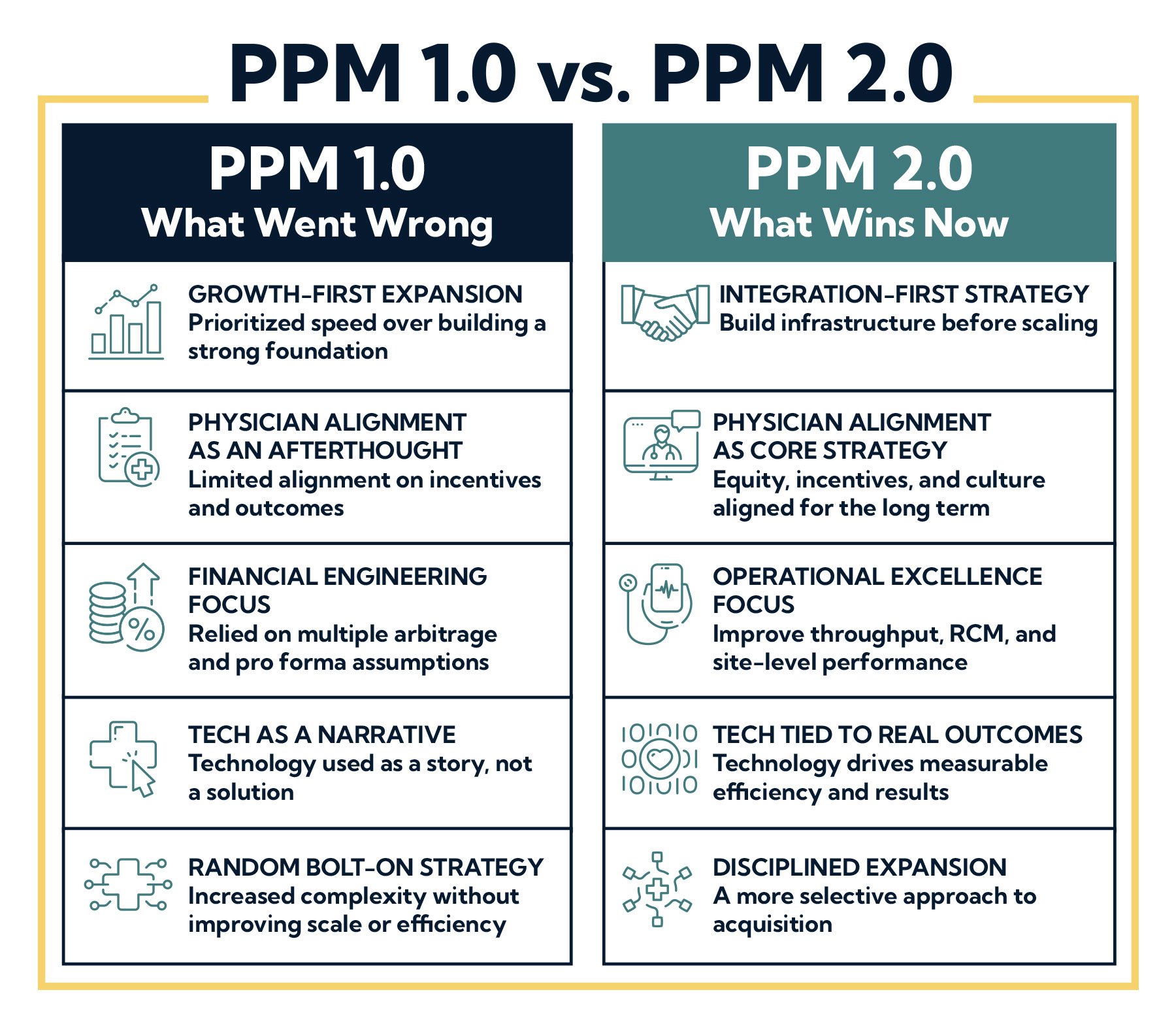
Today's PPM investors are approaching opportunities with a more operationally grounded mindset. Buyers are prioritizing durability over speed and execution over expansion. This shift has moved toward:
Platforms are increasingly being built with infrastructure in place before expansion begins. That includes centralized systems, consistent reporting, and scalable operational processes. Growth may come more slowly at the start, but it is more likely to hold over time.
The focus is shifting toward:
Physician relationships are no longer treated as a secondary consideration. They are central to platform success. Diligence now places greater emphasis on provider retention risk and long-term alignment, not just current productivity.
Buyers are focusing on:
There is a clear shift toward improving the fundamentals of how practices operate. At the same time, reliance on multiple arbitrage alone as a value driver is declining.
Key focus areas include:
Technology remains a major part of the thesis, but expectations have changed. Buyers are looking for real use cases that drive measurable outcomes. PitchBook highlights growing adoption of these types of solutions across healthcare, particularly where they directly improve operations rather than simply adding new capabilities.
Examples include:
Add-on acquisitions are still a core part of the PPM model, but they are being approached more selectively. Random bolt-ons that increase complexity without improving scale or efficiency are being avoided.
Stronger platforms are prioritizing:
Even with a more disciplined approach, PPM deals can still encounter familiar challenges. Healthcare remains highly localized and specialty-specific. Assumptions that overlook those differences can create gaps between expectations and actual performance.
Common pitfalls include:
For independent sponsors, search funds, and smaller private equity groups, PPM remains an attractive space, but it requires a clear understanding of the operational lift involved.
Where these buyers can win:
Where caution is needed:
PPM today represents a more disciplined version of a model that still has strong underlying fundamentals. The opportunity is real, but execution risk remains high without the right foundation. Buyers who can integrate effectively, align physicians appropriately, and expand with discipline have the opportunity to build highly valuable, scalable platforms.
The recent investment cycle reinforced the opportunity within physician practice management while highlighting the importance of execution. The next phase of growth will likely belong to organizations that can integrate effectively, align physicians, and build durable operating models. Winners in PPM will not be the fastest buyers. They will be the ones who build the strongest businesses.

The SBA's new SOP 50 10 8.1, effective October 1, 2026, adds a formal Quality of Earnings (QoE) requirement to certain SBA-financed acquisitions...

Discovering that Form 5471 wasn't filed with your tax return can be unsettling. The IRS imposes significant penalties for missed international...

 Joe Hellman, CPA: August 20, 2026
At our recent Corporate Development event, 2026 M&A Market Update, panelists discussed the forces shaping deal activity midway through the year and...